
Most enterprise financial operations are built on a dangerous assumption: that human oversight can catch errors before they cause systemic damage. When transaction cycles occurred over hours or days, batch reconciliation and post-facto auditing were sufficient to protect the enterprise.
Today, autonomous agentic systems execute complex, multi-step transactions in milliseconds. An LLM-driven procurement agent can read an incoming invoice, match it against a contract, authorize a payment via API, and reconcile the ledger without a single human click.
This operational velocity introduces unprecedented structural risk. If an agent falls victim to indirect prompt injection through a malicious invoice, or simply hallucinates a decimal point during payload generation, the financial damage is done before the security team receives an alert. Relying on end-of-day batch reconciliation to police autonomous agents is equivalent to trying to catch a bullet with a net.
The Death of the Post-Facto Audit
Traditional governance relies on hindsight. Internal audit teams review logs weekly, monthly, or quarterly to identify anomalies and correct errors. This approach assumes that mistakes are slow-moving, visible, and easily reversible.
In agentic workflows, mistakes scale exponentially. A single misconfigured loop can trigger thousands of API calls and unauthorized transactions in minutes. According to data from the Association of Certified Fraud Examiners (ACFE), organizations lose an estimated 5% of revenue to fraud annually, with slow detection being the primary driver of loss magnitude. When autonomous agents operate at CPU speed, that detection window must shrink from days to milliseconds.
Waiting for a post-facto audit log is no longer a viable risk-mitigation strategy. Operations leaders must shift from a reactive detection posture to an inline prevention posture.
The Architectural Blueprint for Inline Governance
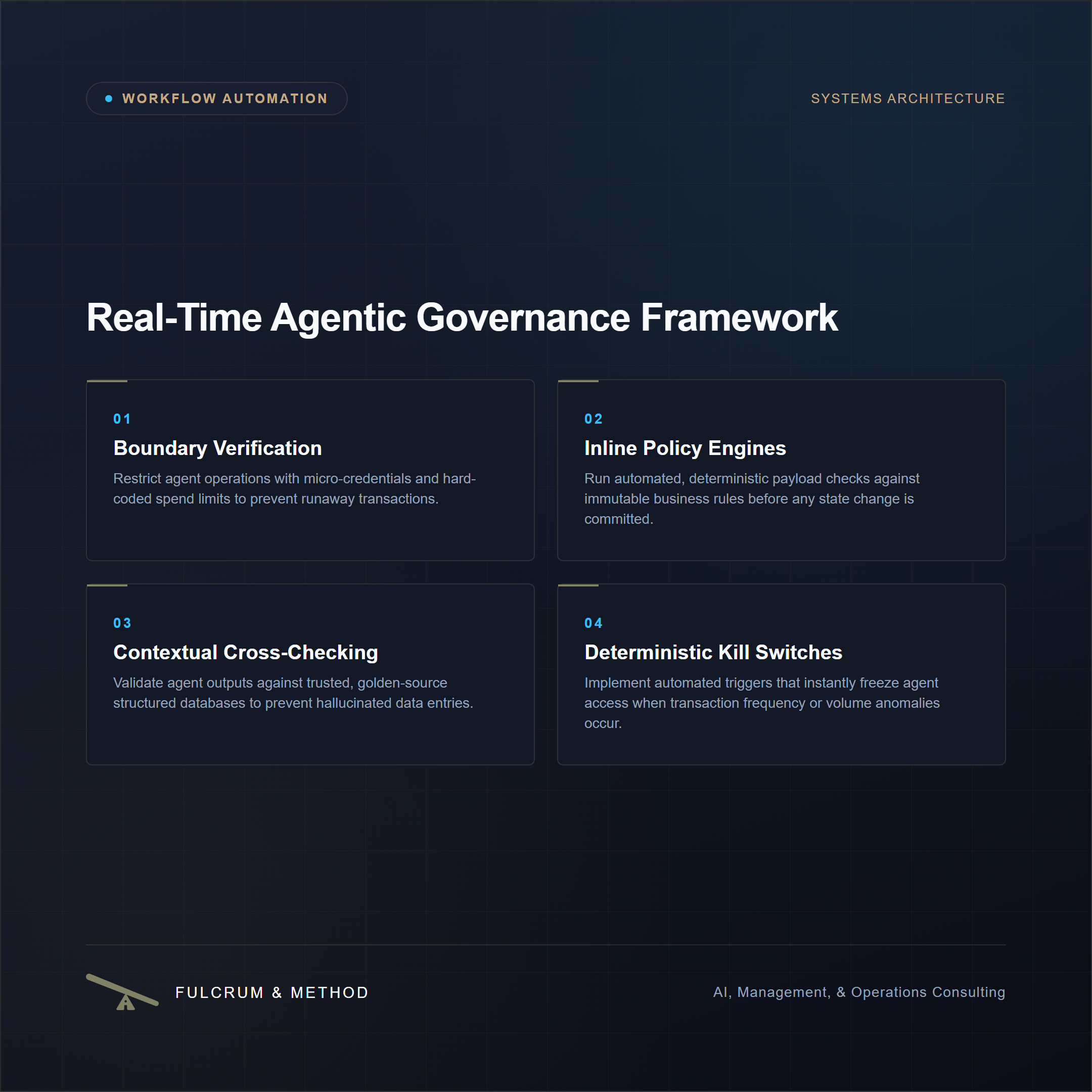
Inline governance requires placing validation gates directly inside the transaction execution path. No autonomous agent should possess the authority to commit financial state changes without passing through an independent, deterministic verification layer.
Rather than attempting to build smarter agents—which increases token costs and latency—organizations must build a rigid, external runtime environment. This architecture consists of three distinct layers:
- The Policy-as-Code Engine: Before any transaction is sent to an external payment gateway or ERP system, the payload must be validated against hardcoded, immutable business rules. If an agent attempts to approve an invoice that exceeds the contract limit, the policy engine blocks the transaction automatically.
- The Contextual Verification Layer: This layer cross-checks the agent's output against trusted structured databases. It answers a simple question: Does this transaction match historical reality? If an agent attempts to pay a vendor whose bank routing number changed without an authorized purchase order change, the system pauses execution.
- The Behavioral Sandbox: Agents should operate within highly restricted permission boundaries. Rather than granting broad API access, assign agents micro-credentials that limit transaction volume, frequency, and total dollar value within a given window.
Solving the Latency Bottleneck
The primary objection to inline governance is latency. Business leaders worry that adding verification steps will slow down automated workflows, defeating the purpose of deploying agents in the first place.
This is a false choice. Effective inline governance does not require running heavy, slow LLM evaluations during the transaction path. Instead, it relies on lightweight, deterministic code.
While the agent uses complex reasoning to generate the transaction, the guardrail system uses simple, pre-compiled rules to validate it. A Python-based policy check can evaluate a transaction payload against a database of authorized vendors and spend limits in under 10 milliseconds.
By segregating the "thinking" (done by the agent) from the "policing" (done by deterministic code), you maintain sub-100ms execution speeds while ensuring absolute compliance.
The Path Forward for Operations Leaders
Transitioning to real-time governance requires an operational reset. Start by mapping your existing agentic workflows and identifying every point where an autonomous system has the authority to write data or move funds.
Deploying inline guardrails is not about restricting the capability of your systems; it is about building the infrastructure that allows them to run safely at maximum velocity. The organizations that win the agentic arms race will not be those with the fastest agents, but those with the most resilient guardrails.