
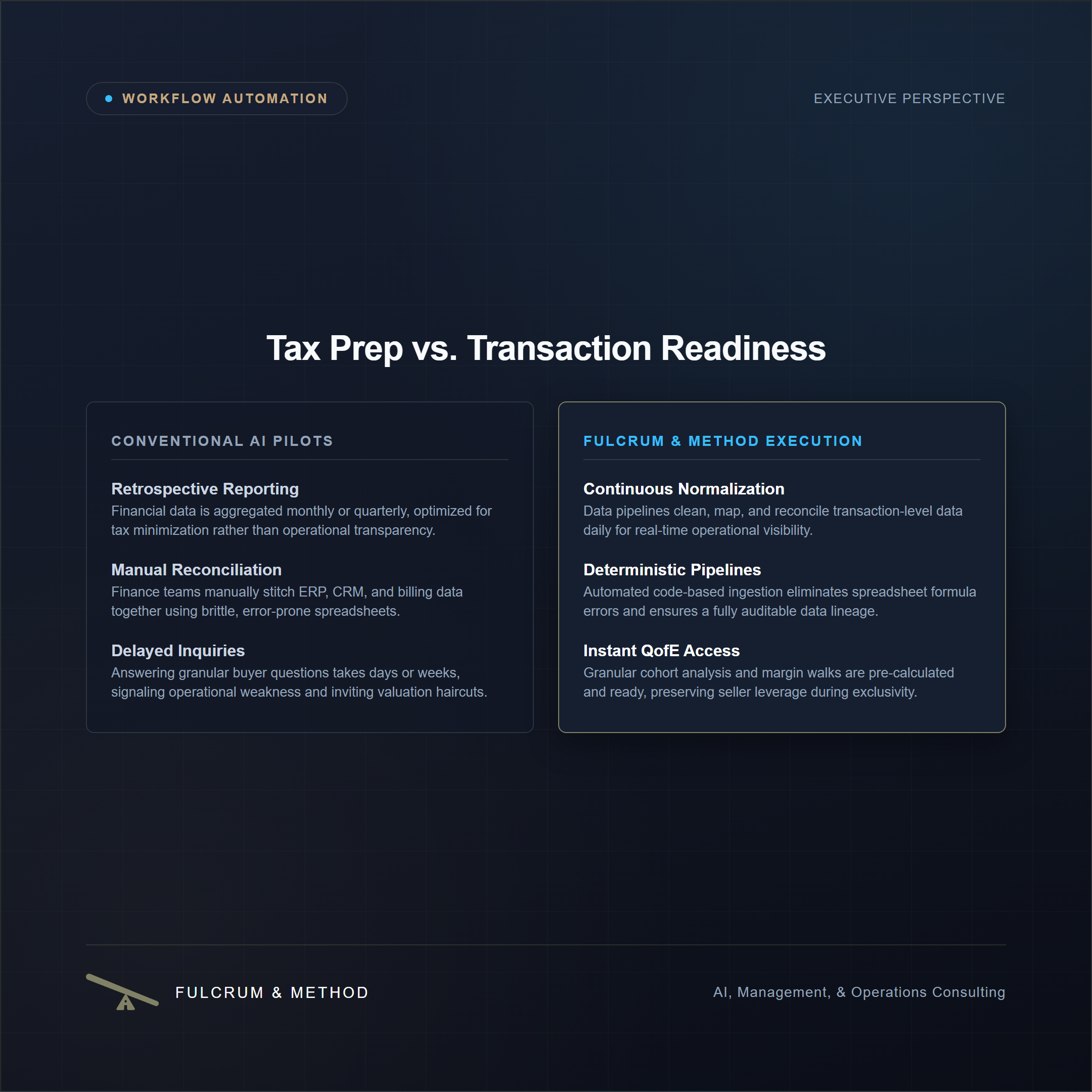
In middle-market M&A, the signing of a Letter of Intent (LOI) marks a dangerous inflection point. Before the LOI, the seller holds the leverage: multiple bidders, competitive tension, and controlled disclosure. The moment the LOI is signed, the power dynamic flips. The buyer secures exclusivity, the competitive pressure vanishes, and the buy-side Quality of Earnings (QofE) team descends on the target company's financial records.
This is where the "diligence dip" occurs.
Most mid-market organizations operate with finance teams and systems structured for tax compliance rather than transactional scrutiny. Tax compliance requires retrospective, aggregated, and quarterly or annual reporting. Transactional diligence, however, demands real-time, unit-level, and highly granular operational scrutiny. When a buy-side accounting firm requests a customer-by-customer margin walk, SKU-level cohort retention, or historical deferred revenue reconciliations, the seller’s finance team is forced to scramble.
This scramble causes delays. Delays breed suspicion. Suspicion leads to valuation haircuts, renegotiated terms, or complete deal failure. To preserve enterprise value, operators must replace retrospective accounting practices with automated, transaction-ready data pipelines long before entering the market.
The Anatomy of the Diligence Dip
When a seller cannot answer a complex financial query within 48 hours, the buyer’s deal team assumes one of two things: either the seller is hiding unfavorable performance, or the seller does not understand their own business operations. Both conclusions damage the seller's leverage.
The root cause of this delay is almost always a structural misalignment in data architecture. Mid-market companies typically run on a patchwork of disconnected systems: an ERP or accounting system (e.g., QuickBooks Enterprise, NetSuite), a CRM (e.g., Salesforce, HubSpot), and various billing or inventory management tools.
Because these systems do not natively talk to each other, the finance team relies on manual spreadsheet reconciliation to build transaction reports. This manual approach introduces three critical vulnerabilities:
- Inconsistent Customer Identifiers: "Acme Corp" in the CRM is "Acme Holding Company, LLC" in the billing system, making automated customer-level analysis impossible without manual mapping.
- Aggregated Revenue Recognition: Monthly revenue is recorded in bulk journal entries, obscuring the underlying transaction-level detail required to analyze product margins or customer cohorts.
- Brittle Version Control: Critical calculations live in complex, macro-heavy Excel sheets maintained by a single key employee. If that employee leaves or makes a formula error, the entire diligence process stalls.
Building the Continuous, Transaction-Ready Pipeline
Resolving this structural deficit does not require a multi-million-dollar enterprise software overhaul or speculative artificial intelligence. Instead, it requires a deterministic data pipeline designed to continuously normalize operational data into an audit-ready format.
Phase 1: Deterministic Ingestion and Schema Alignment Rather than relying on manual exports, operators should establish direct APIs or automated database connectors to pull raw data from the ERP, CRM, and billing systems into a centralized database.
Once ingested, the first task is automated entity resolution. Using deterministic matching rules and standardized lookup tables, the pipeline maps disparate customer names and transaction codes into a single, unified master record. This ensures that every transaction is tied to a verified customer profile, regardless of how it was entered in the source system.
Phase 2: Automated Reconciliation and Margin Calculation With unified customer and transaction records, the system can automate the calculations that buy-side analysts prioritize:
- Unit-Level Gross Margins: Automatically matching direct labor and material costs from the ERP to specific sales transactions in the billing system.
- Cohort Retention Analysis: Grouping customers by acquisition date and tracking their spend patterns month-over-month to demonstrate stable, recurring revenue.
- Working Capital Tracking: Monitoring rolling accounts receivable (AR) and accounts payable (AP) aging cycles to establish a clean historical baseline.
Because these calculations are performed by automated scripts rather than manual spreadsheet manipulation, every output is repeatable, auditable, and instant.
The Strategic Value of Transaction Readiness
Transitioning to an automated, transaction-ready posture yields massive operational and financial returns during a sale process.
First, it shortens the exclusivity window. Every day a deal remains under LOI is a day the buyer can find an excuse to renegotiate the price. By delivering a comprehensive, pre-audited data room on day one, the seller compresses the diligence timeline, reducing the window of vulnerability.
Second, it neutralizes buy-side re-trading tactics. If a buyer claims that customer churn is accelerating, the seller does not need to spend a week compiling data to refute it. They can pull up-to-the-minute, system-verified cohort reports that prove the stability of the revenue stream.
Finally, it reduces organizational strain. Preparing for a sale is exhausting for management teams. Automating the heavy lifting of data preparation allows the CFO and executive team to focus on running the business, preventing the operational performance dip that often occurs during prolonged transactions.
Maximum enterprise value is not achieved through clever negotiation alone; it is secured by operational excellence that leaves no room for buyer doubt. Build the pipeline before the bankers arrive.