
Most enterprise content strategies suffer from a fundamental architectural flaw: they treat creation and distribution as a single, combined process.
When a company decides to expand its digital footprint—moving from a core technical blog to LinkedIn, X, YouTube Shorts, and industry-specific newsletters—the immediate operational response is to hire. Teams bring on platform-specific copywriters, video editors, and social media managers.
This approach creates a linear cost curve. To double your platform coverage, you must nearly double your headcount or agency spend. For operations executives, this is a negative-leverage trap. The marginal cost of distributing an existing insight to a new channel remains stubbornly high, while the return on attention on any single platform continues to decay due to algorithmic volatility.
To capture early-mover advantages on emerging micro-platforms without exploding operational costs, organizations must decouple core intellectual property from platform-specific formatting. The solution is the implementation of a central Semantic Media Layer (SML).
The Core Concept: Decoupling Insight from Format
In software engineering, the separation of concerns is a foundational principle. Databases store raw data, APIs transport it, and front-end frameworks render it for the user. A change in the user interface does not require a rewrite of the database.
Modern digital distribution should operate on the same principle.
An executive insight, a proprietary data point, or a technical framework is the "data." A LinkedIn post, an X thread, or a short-form video script is merely the "front-end wrapper."
``` [Raw Source Material] │ ▼ [Semantic Media Layer] <-- Structured JSON Schema (Key ideas, data, quotes) │ ┌─────┼─────┐ ▼ ▼ ▼ [X] [LinkedIn] [Short Video Scripts] <-- Programmatic Presentation Wrappers ```
When you force creators to write directly for a specific platform, you lock valuable intellectual assets into highly ephemeral formats. A beautifully written LinkedIn post is difficult to programmatically repurpose for a technical newsletter because the core arguments are already fused with platform-specific hooks, emojis, and character limits.
By establishing a Semantic Media Layer, you extract raw, unstructured knowledge from your subject matter experts and organize it into a structured, platform-agnostic schema. Once structured, this semantic data can be programmatically rendered into dozens of platform-specific assets at near-zero marginal cost.
The SML Architecture: A Three-Tier System
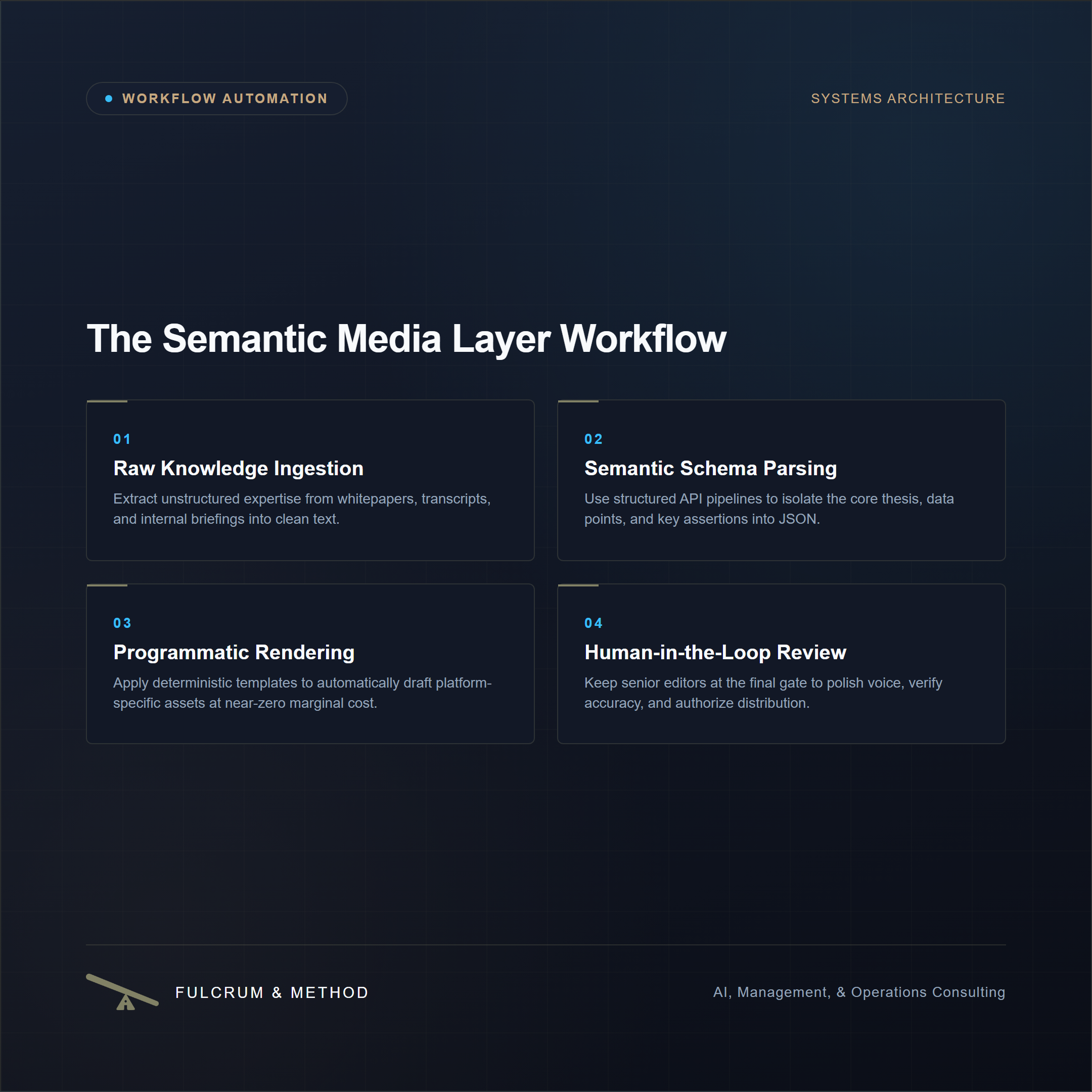
Building a Semantic Media Layer does not require a multi-million-dollar custom enterprise platform. It requires a disciplined, three-tier workflow architecture built on deterministic data processing and targeted LLM inference.
1. The Ingestion Tier (Unstructured to Semi-Structured) The process begins with raw source material. This could be a transcript of an internal technical briefing, a 20-page whitepaper, or a raw product demo video.
Instead of handing this material to a writer to "draft some posts," the material is run through an ingestion pipeline. Automated transcription tools convert audio to text, and basic text-parsing scripts clean up formatting. The goal is to isolate the raw informational density of the asset, stripping away conversational filler and redundant phrasing.
2. The Semantic Schema Tier (The Core Database) This is the heart of the system. The cleaned text is processed using LLM APIs configured with strict structural schemas (such as Pydantic in Python). The model is instructed to parse the raw text and populate a standardized JSON schema.
A typical semantic schema includes: * Core Thesis: The primary contrarian or analytical argument. * Supporting Assertions: 3 to 5 distinct sub-arguments that prove the thesis. * Empirical Evidence: Specific statistics, benchmark numbers, or case study metrics (with strict source attribution). * Technical Definitions: Clarifications of proprietary terms or complex methodologies. * High-Impact Quotes: Direct, punchy statements from the subject matter expert.
By converting unstructured expertise into a structured JSON payload, the insight becomes machine-readable. It is now completely decoupled from any distribution channel.
3. The Programmatic Rendering Tier (Multi-Platform Generation) With the structured semantic layer complete, you run targeted, deterministic templates to generate platform-specific drafts.
Instead of asking a general-purpose AI to "write a LinkedIn post about our new whitepaper"—which invariably results in generic, cliché-ridden output—you feed the specific JSON payload into highly constrained, platform-specific rendering prompts.
- For LinkedIn: The prompt uses the Core Thesis as a hook, references the Empirical Evidence, and structures the body around the Supporting Assertions.
- For an X Thread: A script breaks the Supporting Assertions and Empirical Evidence into a series of highly concise, chained posts.
- For a Video Script: The prompt formats the Core Thesis and High-Impact Quotes into a two-column script format (Visual/Audio) with a target read-time of 55 seconds.
Because the generative models are only responsible for formatting structured data rather than inventing ideas, the rate of hallucination drops to zero, and the stylistic output remains highly consistent.
The Unit Economics of Scale
To understand the strategic value of this transition, consider the shift in unit economics for a mid-sized B2B enterprise producing four major research reports per year.
The Legacy Model (Linear Labor) * Production: 1 core research report. * Repurposing: 10 LinkedIn posts, 3 X threads, 2 newsletters, and 5 short-form video scripts. * Labor Cost: Approximately 40 hours of manual copywriting, formatting, and cross-checking across various marketing team members (estimated at $3,000 in labor costs per campaign). * Cycle Time: 2 to 3 weeks of back-and-forth drafting and approvals.
The Semantic Layer Model (Programmatic Leverage) * Production: 1 core research report. * Repurposing: The report is ingested and structured into the Semantic Media Layer. * Execution: Automated scripts generate 30 distinct, platform-specific draft assets in under 5 minutes. * API Cost: Less than $2.00 in token usage. * Human-in-the-Loop Review: A senior editor spends 2 hours refining, polishing, and approving the generated drafts (estimated at $150 in labor costs). * Cycle Time: Less than 24 hours from report finalization to a fully populated multi-platform campaign.
By shifting the heavy lifting of structural formatting from human labor to programmatic automation, the marginal cost of asset creation drops by over 90%. Your editorial team shifts from low-leverage formatting to high-leverage quality control and strategic distribution.
Implementing the Semantic Media Layer
Organizations looking to deploy this architecture should avoid the temptation to build a massive, all-encompassing system from day one. Instead, execute a simple three-step pilot:
- Define Your Schema: Determine the 5 to 7 structural elements that make up your organization's unique intellectual capital (e.g., problem statement, proprietary framework, client metric, step-by-step resolution).
- Build a Single Pipeline: Write a basic Python script that uses the OpenAI or Anthropic API with structured output mode enabled. Feed it a transcript of an internal technical meeting and verify that it accurately populates your schema.
- Isolate the Review Gate: Never automate publishing. The goal of the Semantic Media Layer is to automate the drafting phase. Keep a human editor firmly at the gate to ensure brand voice alignment, nuance, and final polish.
As platform fragmentation increases and new channels emerge, the organizations that thrive will not be those with the largest creative headcounts. They will be the ones that have built the infrastructure to programmatically deploy their intellectual property wherever their audience happens to assemble.
🔗 Ingested Source Material & References - [Inc. Magazine] This New Jack Dorsey-Backed Social Media Platform Is Bringing Back The Magic of Vine. Founders Should Jump In Early >
DiVine is bringing back Vine’s six-second magic. It’s an opportunity for founders to gain digital leverage fast.
...- [Inc. Magazine] 65 Percent of Small Businesses Have a Problem That Can Quietly Kill a Sale Before Closing
- [Inc. Magazine] Founders Think the Letter of Intent Locks In the Deal. It Often Locks In Their Weakness
- [BCG AI Insights] Risk Management and Compliance
- [Bain AI Insights] Healthcare & Life Sciences