
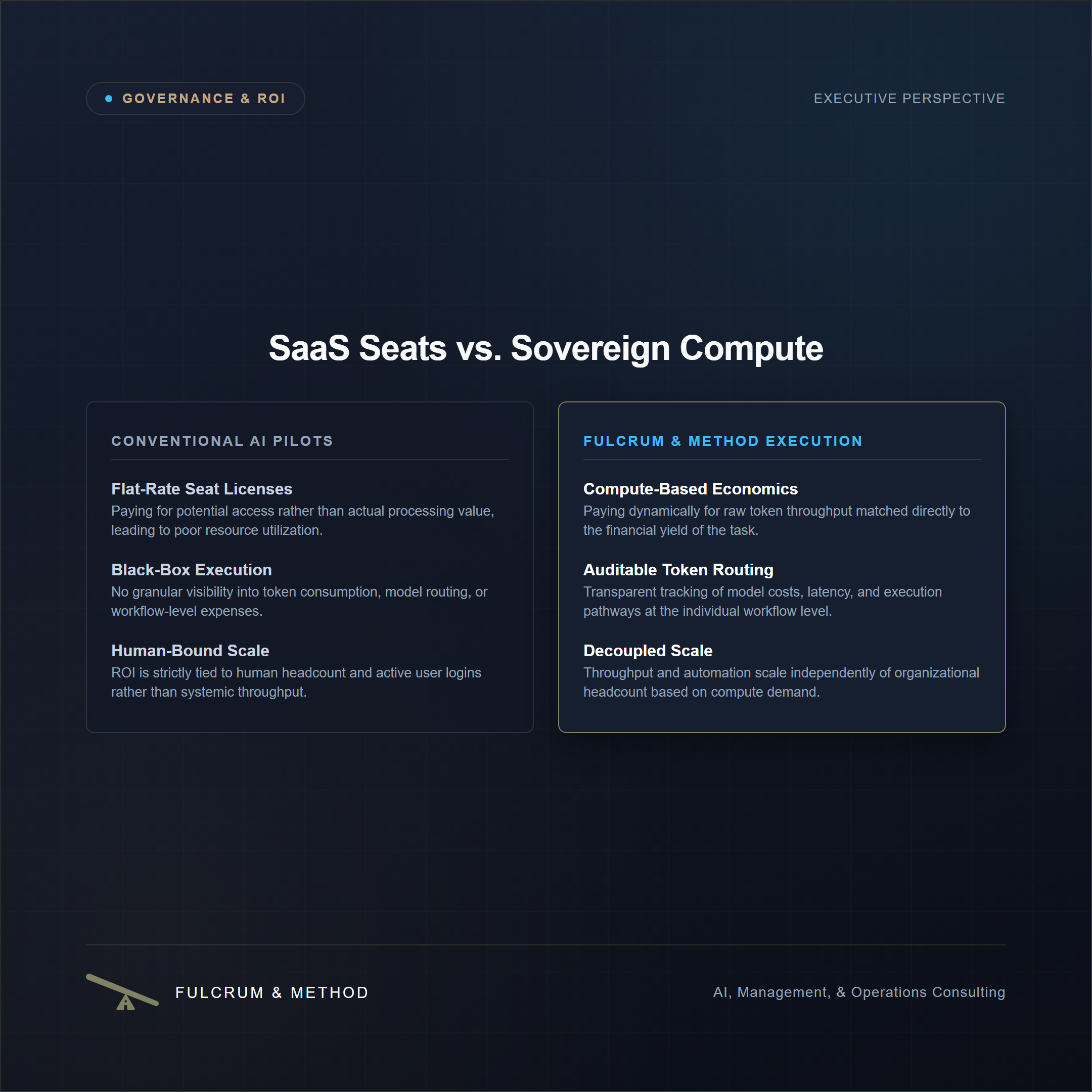
For the past two decades, enterprise software procurement has followed a predictable, comfortable script: the per-seat Software-as-a-Service (SaaS) subscription model. Finance departments understand it, procurement teams have optimized its negotiation, and IT departments use it to project annual operating expenses with high predictability.
But as organizations shift from passive copilots to autonomous agentic workflows, this pricing structure is breaking down.
An enterprise agent does not sit at a desk. It does not work an eight-hour shift, and it does not consume software resources in a linear, predictable fashion. An agentic system can lie completely dormant for days and then execute millions of tokens of complex, multi-step reasoning in a three-minute window to resolve a supply chain bottleneck.
Evaluating these systems through the lens of flat-rate SaaS seat licenses is an operational mismatch. It obscures the actual cost of execution, limits architectural flexibility, and prevents leadership from calculating true return on investment. To capture the margin expansion promised by artificial intelligence, enterprise leaders must transition from an OpEx seat-licensing mindset to a capital asset model focused on dynamic compute-to-value ratios.
The Economic Collapse of the Seat License
The seat license model is built on an underlying assumption: value is directly proportional to human headcount. If you have 500 customer service agents, you buy 500 licenses of your CRM and ticketing software.
When you introduce autonomous agents, this logic fails for two primary reasons:
- Asymmetric Resource Consumption: A single human operator might generate 10,000 words of text a day. An autonomous agent routing API calls, validating database schemas, and synthesizing unstructured documents can consume that volume in seconds. If charged on a flat-rate basis, SaaS vendors must price their seats to cover the worst-case scenario of heavy users, resulting in inflated premiums for average workloads.
- The Disconnection of User to Value: If an agent operates in the background—running daily reconciliations, processing invoices, or auditing compliance records—who owns the "seat"? Charging per developer or per administrator misses the point. The value is generated by the execution of the workflow, not the active session of a human supervisor.
By sticking to seat licenses, enterprises accept a double penalty: they overpay for underutilized seats while remaining blind to the actual processing costs of high-throughput workflows.
The Sovereign Agent Alternative: Compute as CapEx
To build a highly optimized, scalable automation engine, organizations must treat agentic pipelines as sovereign capital assets. Instead of outsourcing the infrastructure to third-party SaaS wrappers, enterprises should own the orchestration layer and manage compute as a variable, raw material.
In this model, the units of economic measurement shift: * From: Cost per seat per month. * To: Cost per completed workflow execution (or Cost per Million Tokens, structured by task complexity).
When you treat compute as a variable asset, you can apply classic manufacturing unit economics to your digital operations. Every step in an automated workflow is evaluated by its compute-to-value ratio: the cost of the tokens required to execute the step versus the financial yield or labor savings of the completed task.
``` Compute-to-Value Ratio = (Cost of Model Inference + Orchestration Overhead) / (Value of Human Labor Displaced + Value of Error Reduction) ```
If a complex reasoning task requires a high-end frontier model running deep tree-of-thought search, it may cost $4.50 in compute resources to execute. If that task resolves a billing discrepancy that typically takes a human analyst 30 minutes ($25 in fully burdened labor cost) to fix, the compute-to-value ratio is highly favorable (approximately 1:5.5).
Conversely, running a multi-agent loop with frontier models to draft a routine internal status email is an economic failure. By measuring unit economics at the workflow level, systems architects can dynamically route tasks to the cheapest possible model that can reliably execute them.
The Architectural Blueprint: Dynamic Token Routing
Transitioning to compute-based unit economics requires a shift in technical architecture. Enterprises cannot rely on monolithic, closed-source platforms that hide their processing costs behind a single subscription fee. Instead, they must implement a sovereign orchestration layer that manages model routing dynamically.
This architecture relies on three key pillars:
1. Tiered Model Selection Not every task requires a multi-billion-parameter frontier model. A robust agentic workflow uses small, fine-tuned, open-weights models (such as Llama-3-8B or Mistral-7B) hosted on private cloud infrastructure for 85% of standard classification, extraction, and formatting tasks. The system only routes to expensive, proprietary frontier models when deterministic validation checks fail or when high-ambiguity reasoning is required.
2. Deterministic Guardrails Before any token is spent on LLM inference, the system should run deterministic Python code to handle data retrieval, schema validation, and simple transformations. Using generative models to clean a CSV file or join two SQL tables is an expensive, error-prone waste of compute. Build the pipe deterministically first; apply cognitive compute only at the bottlenecks.
3. Compute Budgets and Rate-Limiters Just as cloud engineering teams set budgets for AWS or Azure spend, operations teams must establish token and dollar limits for individual agentic workflows. An agent caught in an infinite reasoning loop or processing a corrupted, multi-gigabyte document can quickly burn through thousands of dollars in API costs. Real-time monitoring, circuit breakers, and human-in-the-loop review gates must be built into the orchestration layer to prevent runaway compute spend.
The Path to Implementation
For leadership teams ready to move beyond pilot purgatory and build a disciplined AI strategy, the transition to compute-based unit economics begins with three steps:
- Audit Existing SaaS Wrappers: Identify how many of your current AI subscriptions are simply thin interfaces built on top of public APIs. Calculate the implied cost-per-token you are paying through their seat licenses compared to hosting those models directly in your own cloud environment.
- Establish a Sovereign Orchestration Layer: Invest in internal platform engineering to build or deploy open-source orchestration frameworks. This ensures your workflow logic remains modular and completely independent of any single model provider.
- Redefine Procurement Success: Instruct your procurement and finance teams to stop optimizing for volume-based seat discounts. Instead, negotiate committed-use discounts for raw cloud compute, GPU availability, and high-volume API throughput.
By treating agentic workflows as capital assets with variable unit economics, organizations can run high-yield, high-margin workloads at scale while ruthlessly deprecating low-value automation. The future of enterprise leverage belongs to those who own their infrastructure and manage their compute with the discipline of an industrial manufacturer.
🔗 Ingested Source Material & References - [McKinsey Insights] Governing AI with intention in the social impact sector > As AI adoption grows, mission-driven organizations must weigh how to adopt new capabilities without sacrificing the trust central to every donor relationship, constituent served, and mission pursued....
- [McKinsey Insights] Driving value with an investor mindset
- [McKinsey Insights] How premium leisure travel is rewriting airline economics
- [McKinsey Insights] Putting innovation—and patients—in focus: A conversation with Astellas Pharma CEO Naoki Okamura
- [McKinsey Insights] How instant payments are transforming the financial landscape